Thursday, February 14, 2013

From Roger Fitch and our Friends down under at Justinian


Perfidy in peacetime

The United States doesn't require a war for there to be "war crimes ... Stopping the "water cure" from flowing into the trial process ... European Court of Human Rights upsets the CIA's apple cart ... Roger Fitch files from Washington 
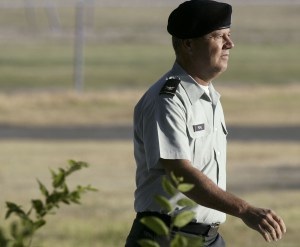
Judge Pohl: obligingly kept torture evidence secretTHE news media have concentrated this month on the Guantánamo 9/11 trial, where, in a moment of high farce, the sound and pictures under the delayed-response security systemabruptly vanished despite no one claiming responsibility. 
As soon as a defence lawyer mentioned his motion to preserve CIA "black sites" (they are crime scenes, after all), someone pulled the plug, and it wasn't the judge or official court censor. 
Whodunnit? The judge didn't know, but the prosecution did.
Equally riveting theatre could be found in a concurrent Gitmo show trial, that of the Saudi Abd al-Rahim al-Nashiri, starring the same judge, Colonel James Pohl.
Nashiri is said to have organised a 2000 attack on the USS Cole in the harbour at Aden.
Yemen was a friendly country with no war and, even with one, the Cole would be a legitimate military target.
It's clearly a civilian offence: when Nashiri's fellow Guantanamero Ahmed Ghailani was accused of bombing US embassies in East Africa, he was tried in New York before a real court and sentenced to life in prison.
To counter the apparent invalidity of Nashiri's commission charges, the  specifications recite self-serving fictions, e.g. in the (only) count describing an actual war crime, "Using Treachery or Perfidy":
"NASHIRI ..., an alien unprivileged enemy belligerent subject to trial by military commission, did, in or around Aden, Yemen, on or about 12 October 2000, in the context of and associated with hostilities, invite the confidence and belief of one or more persons onboard USS COLE ... that two men dressed in civilian clothing, waving at the crewmembers onboard USS COLE ..., and operating a civilian boat, were entitled to protection under the law of war, and intending to betray that confidence and belief, did thereafter make use of that confidence and belief to detonate explosives hidden on said civilian boat alongside USS COLE ..., killing 17 Sailors of the United States Navy ..."
Sadly, without a war, Nashiri can't be a belligerent, or a person subject to trial by military commission by the law of war as required by the Military Commissions Act 2009.
There were no hostilities in Yemen in 2000. 
"Perfidy" is indeed a violation of the law of war, but requires more than waving at the enemy - an accepted ruse in war, unlike, say, waving a white flag.
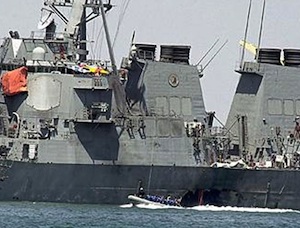
USS Cole: should be civilian offencesNashiri wasn't originally portrayed as the Colebombing mastermind. When the other Coleaccused were indicted in New York in May 2003, Nashiri was merely an "unindicted co-conspirator".
Though already in US custody, Nashiri was not produced in New York.  Apparently, the CIA was too busy torturing him in Poland in the hopes of producing incriminating "evidence" for the Manhattan cases.
The CIA admits Nashiri was waterboarded while detained by the CIA in Thailand, Poland and Romania.
Some of his treatment - as verified by the CIA Inspector General - included acts that are themselves classic war crimes, e.g. pistols and electric drills held to the head, and the "water cure". 
His treatment also violates US law implementing the Convention against Torture. 
As part of a mental health evaluation, Judge Pohl has agreed to let a military medical panel examine Nashiri's CIA file, including the time of torture.
However, if Nashiri hopes disclosure of torture by the CIA will assist his defence, he need only refer to a ruling by Judge Pohl in the 9/11 proceedings, that torture evidence must be kept secret on "national security" grounds - e.g. the fact it would make the CIA, Thailand, Poland, Lithuania and Romania look bad, or worse, subject them to some civil or criminal punishment.
In the end, Judge Pohl had no difficulty finding jurisdiction in Nashiri's case, by accepting there was a war in Yemen in 2000:
"The political branches have made a determination that hostilities existed between al Qaeda and the United States prior to September 11, 2001 and on the dates of the alleged offenses, evidenced by the passage of the 2009 MCA, the referral of charges in this case, and the litigation of this case since arraignment ... The political branches' collective determination is entitled to judicial deference by this commission."
In other words, if the MCA claims it applies to offences occurring before September 11, 2001, and the government prosecutes Nashiri for something that happened in 2000, the "political branches" - Congress and the president - have decided there was in fact a war in 2000, and that "decision" deserves deference. 
As Kevin Jon Heller observed, "Judge Pohl's decision is one of the worst ever issued by a military-commission judge.  And that, my friends, is saying something".
*   *   *
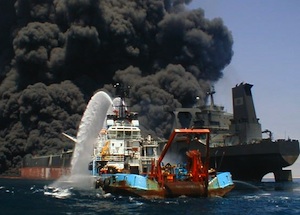
MV Limburg: cutting edge kangarooIF perfidy in peacetime seems a stretch, consider one of the other "war" charges against Mr Nashiri, that of planning a 2002 suicide bombing in the Gulf of Aden that killed a Bulgarian on a Luxembourg-flagged French tanker, the MV Limburg. 
This is cutting-edge kangaroo: an act in international waters with no connection to the US or any war.
No problem. According to the Pentagon, the attack on the Limburg "could effect (sic) not only our own but potentially global economies. It was an oil tanker just outside the Straits of Hormuz".
Well, there you have it: it's clearly a war crime if oil is involved.
Still, why not use the 200-year old piracy laws just upheld by the Supreme Court
A nearly identical case is being treated as piracy.
*   *   *
THE decision by the European Court of Human Rights in El-Masri v Macedonia (see previous post) proves the danger of serving as proxy for the CIA, and must worry other European nations being sued in the ECHR. 
Mr Nashiri, for instance, has ECHR cases pending against both Poland and Romania.
The countries in strife are all former Communist regimes.
Two of them, Poland and Lithuania, started working with the CIA barely a decade after ridding themselves of the hated Russians and their KGB. 
One of the more ironic moments of the post-Communist era must be Donald Rumsfeld's solemn 2005 pilgrimage to the former KGB headquarters in Vilnius, Lithuania (now a memorial to victims of Russian oppression) while the CIA ran a similar torture dungeon just outside the city.  
Meanwhile, Polish newspapers are reporting the existence of a document signed by Poland's former prime minister concerning the secret CIA prison in that country and what to do "if a dead body of one of the persons held there should appear".
Gosh.

Friday, December 7, 2012

FROM ROGER FITCH AND OUR FRIENDS DOWN UNDER AT JUSTINIAN


Obama's republic
Tuesday, December 4, 2012
Justinian in Cobell v Salazar, Donald Rumsfeld, Drones, Military detention, Roger Fitch Esq, US Presidential election
Shock: the rich prefer Obama ... Democrats outvoted Republicans, but state gerrymanders keep GOP in control of the House ... Recomposition of the ultra-orthodox DC Circuit ... Rumsfeld gets torture immunity ... Native American compensation claims settled after 16-year class action ... New policy for drone assassinations ... Roger Fitch reports from Washington 
The Presidential election wasn't even close
"The government consists of a gang of men exactly like you and me. They have, taking one with another, no special talent for the business of government; they have only a talent for getting and holding office. Their principal device to that end is to search out groups who pant and pine for something they can't get and to promise to give it to them. Nine times out of ten that promise is worth nothing. The tenth time is made good by looting A to satisfy B. In other words, government is a broker in pillage, and every election is sort of an advance auction sale of stolen goods."
H. L. Mencken (1880-1956)
THE precipitous decline of the American republic has been slowed - if not arrested - by the re-election of Mr Obama and the rejection of a Republican Senate.
The pillage du jour - in this case, the systematic looting of the nation's dwindling assets by Republicans and their rapacious corporate allies - has been momentarily interrupted. 
Still, Mr Obama and the Democrats are not entirely trustworthy (see below) as the US faces a so-called "fiscal cliff" in which unpleasant choices in spending cuts may be forced on a recalcitrant Congress. 
Now that it's all over, Obama has survived, perhaps through the intervention of Mother Nature in the form of the super-storm Sandy. 
The election result was a blow for Rupert Murdoch, who deployed over 30 of his people nationwide to campaign for Republicans.
Six billion dollars may have been spent in this year's election cycle - over $500 million of it by special interest groups in the last month.
As it turned out, the presidential election wasn't even close, historically speaking, but unpredictable things happened, considering the Republican candidate's wealth and religion.
The rich apparently preferred Obama, and a greater percentage of Mormons supported George Bush when he last ran than supported Romney this year.
With Democrat candidates for Congress receiving more votes than Republicans, you would think Obama would have a Democrat majority in the House - as he does in the Senate - but thanks to Republican state-based gerrymanders, the opposition kept control of the House while losing the popular vote
It's one of the few times in the last 100 years that the losing party in the House still got control of it
While  Republicans lost the popular vote, they have one of their biggest House majorities in 60 years. That won't be easy to change: only 74 of the 435 House districts remain marginal, or "competitive." 
The Republicans still have the edge in statehouses, where gerrymanders of federal constituencies are made. 
Come January the Republicans will have complete control of 27 states versus 19 for the Democrats. Only three states have split legislatures, and Nebraska is unicameral.      
Some say the Republicans have lost the culture war.
Perhaps, too, the claim that the US is a "Christian nation" can be laid to rest
The Republican "Southern Strategy" of targeting "White Anglos" is also breaking down.
With Texas now having a majority-minority population of 55 percent, the days of Republican-dominance in that state are numbered.
In Florida, another state becoming competitive for Democrats, there was a gratifying removal of the accused war criminal Allen West, a Republican, from his House seat. At the same time, the liberal Florida Democrat Alan Grayson, ousted in the Republican sweep of 2010, was returned to Congress. 
The conservative Washington Post doesn't like either of them.
There were other pleasing results such as the failure of big money to buy influence in state judicial elections.
*   *   *
ALTHOUGH federal judges are not elected, one bright spot in the election may turn out to be the future composition of the ultra-orthodox DC Circuit.
With Obama having won four more years, David Sentelle, the most partisan Republican on the DC Court (see my post here) has decided to take senior status
There are four vacancies to be filled in DC, a golden opportunity for Obama to reshape this "second-most important" federal court and break the ideological edge held by Republican operatives and "movement conservatives". 
With four years, the president hopes to do the same with the Supreme Court. And with good reason - a new study confirms what we always knew: conservative justices invalidate liberal laws, and vice-versa.     
*   *   *
PRESIDENT Obama is defending the seemingly unconstitutional provisions of the National Defence Appropriation Act that purport to allow indefinite extrajudicial (military) detention of US civilians in the US and abroad.
Sadly, he has the amicus support of Senate Republicans.  
Meanwhile, with the election safely out of the way, DoJ has signed a sweetheart settlement in the robo-signing mortgage scandal that makes recovery by civil plaintiffs more difficult.
*   *   *
THE 7th Circuit, sitting en banc, has overruled a unanimous three-judge appeals panel, and given former Secretary of Defence Donald Rumsfeld immunity for torture that he personally ordered.
Jonathan Hafetz, the Times and Kevin Gosztola comment on the case.
*   *   *
THE Native American claims case Cobell finally ground to completion after 16 years when the DC Circuit signed-off on the settlement
The case has a long and sordid history, including the shock removal by the DC Circuit of the now Senior DC District Court judge, Royce Lamberth, who imprudently alluded to the racism of the Bureau of Indian Affairs and held two Secretaries of the Interior in contempt. 
The government never did account for the amount of Indian trust funds converted to other use over the last 135 years.
The $3.4 billion settlement, reached in 2010 but delayed until Congress appropriated the money, is paltry compared to the loss the Indians suffered.
*   *   *
THE Obama administration has produced a policy for drone assassinations at last: they were afraid to leave it to Mr Romney.
Disturbingly, the Times saw merit in institutionalising - bureaucratically - a practice long considered criminal by the US government itself.
It's too late, of course, for Anwar al-Awlaki, the American who was assassinated by CIA drone in Yemen in 2011. 
But, the US is now claiming he was no longer a citizen anyway when they killed him, and they had been thinking about charging him with something
Meanwhile, though drone due process is still in abeyance for citizens as well as foreigners, the Pentagon has decreed that in future, humans must decide before a drone kills someone. 
Now that's comforting.  

Monday, November 5, 2012

From Roger Fitch and our friends down under at Justinian


Supreme Court timebombs

New term for US Supremes ... Certiorari petitions ... Critical mass theory of constitutional change ... Presidential election and the court ... Judicial techniques ... Conspiracy as a war crime ... The CIA agent who didn't torture winds-up in jail ... Our Man in Washington, Roger Fitch, reports 
THE Supreme Court's new term has started and it's well-covered, as usual, by ScotusBlog, the brainchild of Tom Goldstein.
The court has begun grants of certiorari petitions (including a rare handwritten one), but the vast majority are denied, such as the attempts by two Republican statesto thwart voters.
However, in Texas voter cases, the court could decide to use voter litigation to throw out a whole section of theVoter Registration Act, i.e. the provision that is applied to (mostly) southern states with a history of discrimination against racial and ethnic minorities.
Balkinblog has more.
One case likely to be granted certiorari is the "Pay for Delay" generic drug case.
The government wants the court to  consider the "reverse payments" drug companies make to potential competitors.
Then there's "marriage equality" cases. Eight different petitions concern the federal Defence of Marriage Act.
Already argued is a case that could end affirmative action in US universities and elsewhere. 
Oral argument in the case, Fisher v University of Texas, led to an interesting discussion of the "critical mass" theory of constitutional change.
The case attracting the most attention is Kiobel v Royal Dutch Petroleum and the meaning of 33 words: "The district courts shall have original jurisdiction of any civil action by an alien for a tort only, committed in violation of the law of nations or a treaty of the United States."
It's the entire text of the Alien Tort Statute, a law passed by Congress in 1789
Scotusblog reviews what's at stake. More here.
The Roberts Court normally prefers to limit tort liability for corporations, but how can the conservative majority square that with the Citizens United finding that corporations are "persons" for other purposes? 
One way might be to throw out liability for everybody, individuals as well, so long as all the acts occurred abroad. Lawyers at ExxonMobil, another ATA case, will be watching closely.
The court meanwhile denied cert to Chevron, which was seeking to block an $18 billion Ecuadorian judgment for environmental damage.
The court has refused to hear an appeal of the long-running Hepting v AT&T, the case that involved a telecom's warrantless surveillance of citizens.
Wired and Glenn Greenwald have more. 
The companion EFF v Hepting is still (just) alive.
*   *   *
SCOTUS: the class of 2012
ACCORDING to the liberal-lawyer American Constitution Society, the future direction of the Supreme Court depends very much on who wins this year's presidential election.
A court with an agenda has many judicial techniques available to implement it, e.g. "stealth overruling" and "timebombs".
That's why the court's steep tilt to corporate and conservative causes is attracting media attention, with the Nation devoting an entire issue to the "1 Percent Court"; more here andhere
*   *   *
SALIM Hamdan's appeal of his military commission conviction has been decided by the DC Circuit
The now-repatriated Yemeni argued that Material Support of Terrorism (MST) is not a recognised war crime, and not surprisingly, judges independent of the Pentagon had no trouble finding MST - invented by Congress in 2006 - did not exist in 2001, when Hamdan was supposed to have committed it. 
Michael Dorf comments.
The case was long-delayed and meddled-in by the Pentagon at its Court of Military Commission Review (see my post of June 29, 2011) before reaching the circuit court. Once it got before a proper Article III federal court, even one consisting entirely of Republican appointees, MST was doomed. 
There's more on this important case herehere and here.
The companion appeal from the CMCR, Al Bahlul - a conviction for conspiracy - is still pending and will be rebriefed in light of Hamdan.
Kevin Jon Heller convincingly argues that the decision in Hamdan II will also doom conspiracy as a war crime.
David Frakt has more on Al Bahlul, his former client.
*   *   *
Court with an agenda
THE Supreme Court ruling in Citizens United - that corporations have a right to give politicians unlimited amounts of money from their corporate treasuries as a First Amendment right of free speech - is a gift that just keeps giving for the Republicans and their allies. 
ProPublica reviews the history of money in politics
Emboldened by the Citizens rationale, the US Chamber of Commerce is now attacking anti-bribery laws for allegedly infringing corporate free speech.
The greatest danger of Citizens United, however, may lie in state courts. 
The Atlantic has a series on the disastrous effect it is already having on elected judiciaries. More here and here.  
*   *   *
DC's senior district judge, Royce Lamberth, eventually sided with the Guantánamo Bar on maintaining access to their clients, but it hasn't all gone the lawyers' way: they're now reduced by Pentagon rules to 25 hours a week with their clients. 
Under George Bush they got 63 hours a week at Guantánamo. 
Perhaps more about the Pentagon's protocol for detainee lawyers will be disclosed in WikiLeak's latest release of prison camp policy documents.
In a separate revelation, the chief of the CIA's infamous world-wide abduction and torture program, sorry, "Rendition, Detention and Interrogation Program", has been identified as one Thomas Donahue Fletcher.  Remember that name.
The leaker, former CIA operative John Kiriakou, has pleaded guilty to a violation of theIntelligence Identities Protection Act.  
He'll serve 30 months in prison, but the more serious Espionage Act charges will be dismissed.  
It was the first successful IIPA prosecution in 27 years.
As fellow whistleblower Jesselyn Radack remarked:
"Kiriakou will become the only CIA agent connected with torture to go to jail, and he's the one who refused to commit it and condemned it publicly. Meanwhile, the people who ordered the torture, the lawyers who justified it, the torturers themselves, and the people who destroyed the videotapes of it are all ... free and unaccountable." 
*   *   *
GUANTÁNAMO prosecutors have backed off from their claim that all conversations of commission defendants are presumptively classified: now it's only their "observations and experiences". 
"Each of the accused is in the unique position of having had access to classified intelligence sources and methods. The government ... must protect that classified information."
As Opinion Juris wryly noted, the accused would have happily avoided the treatment they observed and experienced. 
"Unique access," indeed.

Thursday, October 4, 2012

From Roger Fitch and our Friends down under at Justinian


Epic injustice for child soldier

After 10 years at Guantánamo Omar Khadr is transferred to prison in Canada ... Convicted of a war crime for lawful actions against an opposing uniformed soldier in a war ... Perversion of the law of war ... Roger Fitch reports from Washington 
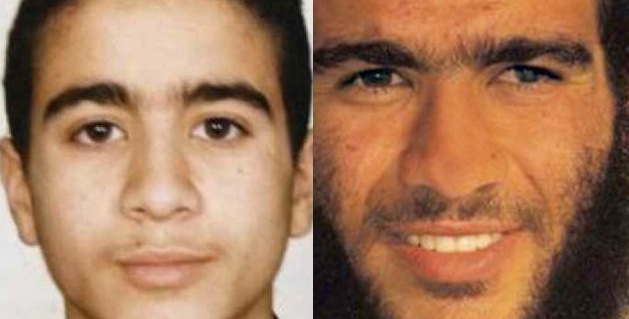
Omar Khadr: then and now
THE Guantánamo prisoner Omar Khadr has been repatriated to Canada, after more than 10 years of patently unlawful American detention. Here's a chronology of his life.
After a year of stonewalling, the Canadian government has agreed to the return of a citizen who is apparently the first person convicted in a military trial for simply killing an enemy combatant - an act that has always been regarded as lawful in war (see post of November 2010).
Omar Khadr's offences seem as much political as military.
In 2002, a child of 15, he found himself, at his father's direction, in an Afghan house that exchanged fire with US soldiers. He had little choice but to defend himself, but an American died.
That a Canadian should actively resist American soldiers offended both governments: he must be punished, and so he was sent to Guantánamo.
All "terror" detentions at Guantánamo have been unlawful, one way or another.
No prisoner has been provided the independent prisoner of war determination required by both the Geneva Conventions and the US Uniform Code of Military Justice.
All have been detained and/or treated in ways that violate multiple international treaties. Omar Khadr's case is one of injustice on an epic scale.
It's hard to know where to start.
First, he was a 15 year old boy caught in a war on his father's initiative. Both Canada and the US seem to have forgotten they are signatories to the "Child Soldier Protocol" that provides that children engaged in war should be regarded as victims whose rehabilitation is paramount.
While much has been made of Omar's purported status as a child soldier and the procedural unfairness of his military commission, what seems to have passed without notice is that he may be the first person ever convicted of a "war crime" for the classic act of war - killing an opposing uniformed soldier.
Khadr had a legal right to resist US attack in a war zone.
Not only did he have a right to self-defence, but, even if he was no more than a civilian who had taken up arms, he was perfectly entitled to shoot at soldiers (including a CIA operative unlawfully involved in the attack on Khadr's compound), so long as no treachery or illegal weapon was involved.
A grenade, which Khadr may or may not have thrown, is not illegal under the Law of Armed Conflict.
Did Khadr even throw the grenade that killed the US special forces soldier?  
The initial US military reports said that another defender who was shot in the battle had thrown the grenade.  But he was killed in the attack, and the report was changed to implicateKhadr, the only survivor.
In fact, the American soldiers may have committed war crimes in capturing Omar Khadr. He was shot twice in the back while badly injured, possibly unconscious, and hors de combat.
It's true that US medical care saved Khadr's life, setting him up for the first-in-history "murder" charges he later faced.
Those charges relied almost entirely on Khadr's "confessions", including the one he gave up under interrogation while lying gravely wounded on a stretcher.
Eventually Omar was taken to Guantánamo where, unlike other juveniles, he was given no special treatment or educational assistance, and held in brutal conditions no different from those of the oldest and most hardened terrorists, often in solitary confinement. 
*   *   *
AT Guantánamo, Omar was questioned by Canadian security officials and the information was shared with the US, a practice stopped by the Canadian courts.
Canada's Supreme Court strongly criticised the refusal of the government to intervene inKhadr's behalf, in violation of that country's Charter of Rights, but stopped short of ordering his repatriation, as a lower court had done.
Khadr was first charged in one of George Bush's executive military commissions but that system was thrown out by the US Supreme Court.
A new military commission was brought against Khadr under the statutory scheme introduced by the Military Commissions Act 2006, and he was charged with five "war crimes" variously unknown to the law of war (e.g. murder) or inapplicable to Khadr (spying).
As soon as the military judge departed from (Pentagon) script - by ruling favourably on a number of Khadr's motions - he was summarily removed, retired and replaced.
A more amenable Pentagon judge later ruled that all of Khadr's "confessions", even those made while wounded, would be admitted. 
Assuming Omar's actions were actually war crimes, these "confessions" would have been enough to convict him. 
His lawyers, like those of David Hicks, were forced to accept a deal involving a guilty plea for invalid crimes.
In pleading guilty, Omar Khadr was obliged to provide from his own mouth all the jurisdictional requirements necessary to sustain such a plea - had the charges themselves been valid. 
Part of the plea involved a diplomatic note from the Canadian government stating that it would be inclined to favourably review a transfer of Omar to a Canadian prison after he had spent one further year at Guantánamo. 
In fact, after that year, the Canadian government obstructed transfer for another year, so that it was not completed until September 28, 2012.
Khadr returns to Canada where over 60 percent of the citizens believe he is a depraved terrorist, incapable of rehabilitation and dangerous to Canadian society, a man unentitled to return to his own country.
Perversely, he's now a danger because he was "radicalised" by his mistreatment.
It's a sad victory for Omar Khadr.
Soon, however, he should be free, notwithstanding the six years of "sentence" he still faces in Canada.
Next year he will be entitled to parole. Should the matter be tested judicially, Canadian courts are unlikely to uphold convictions based on offences unknown to international or Canadian law.
Khadr could even receive an apology and compensation from the Canadian government.
After it allowed the US to render another citizen to Syria for torture, Canada had a formal inquiry, apologised to Maher Arar and paid him over $10 million. 
Omar Khadr deserves no less. 

Saturday, September 1, 2012

From Robert Fitch and our Friends Down Under at Justinian


The President's right to kill Americans

Clients at the Bay ... Everyone's getting tired of "targeted killings" by the "serial assassin" ... Brits pay compo to resident mistreated at Gitmo ... How to make cases go away ... DoJ drops Goldman Sachs prosecution ... Huge public disapproval of Congress ... Roger Fitch reports from Washington 
THE Pentagon wants to curtail Guantánamo counsel's access to their clients once they lose DC habeas cases.
See also and here
Lawyers are likely to learn new things, and it's inconvenient when they put to use what they learn. 
The government still claims every word a detainee utters is a secret, presumptively classified from the moment spoken.
It's a contention presently being contested by the ACLU in Guantánamo's "9/11" trial. 
The Pentagon worries that talk about rendition and torture, sorry, "detention and treatment," could cause "exceptionally grave damage".
Quite so: to the government and its staged military prosecutions. 
To be on the safe side, the Obama administration now claims the bare right to counselexpires after habeas cases are adjudicated. 
The New York Times called the action unconstitutional, and a disapproving op-ed appeared in the Washington Post.
DC Chief Judge Royce Lamberth heard the matter and seemed unpersuaded by the government's arguments.
All of the lawyers have security clearances (so do 4.8 million others in the US), so what's the problem? 
*   *   *
AMERICANS are still trying to get their heads around their president's claim that he has a right to kill them.
The LA Times is fed-up with these "targeted killings", which have a long and sordid history.
In Congress, even the bloodthirsty members want to see Obama's "licence to kill", i.e. the legal opinion supporting the killing of Americans overseas.
Repeated congressional demands for the document have been ignored by Attorney General Eric Holder.   
Jimmy Carter has effectively called President Obama a serial assassin, a view that shockedLawfare's Ben Wittes.
Some US states have murder offences that apply to killing with "depraved indifference" or"extreme indifference for human life".  One example is the law being applied in Colorado to the movie theatre shooter.
These laws are typically applied to acts of firing at random or into crowds - not unlike what happens to mourners at funerals in Afghanistan and Pakistan, apparently being targeted by Obama's assassination program.
Maybe there's a need for a federal "depraved indifference" law to apply to the killing of such civilians, including Americans, often in places where there's no war to which the US is a party, e.g. Yemen (there's  a good discussion of Yemen here)It might also make a worthy addition to the Geneva Conventions.
Meanwhile, an Afghan who says his relatives were unlawfully killed in a case of mistaken identity is suing the British government for its role in compiling faulty "kill lists" for US strikes in Afghanistan.
*   *   *
THE UK police are set to investigate British resident Shaker Aamer's mistreatment atGuantánamo.
He's the last UK-connected prisoner, and has already received a reported £1 million pounds from the UK government in settlement of his civil claims of British involvement in his mistreatment.
Helpfully, the head of Britain's MI6, Sir John Sawers, has publicly confirmed that his agency's equivalent in the US resorted to torture.
Another blunt admission has come from the State Department legal adviser, Harold Koh, who recently referred to Guantánamo as a place where the US - perhaps unwisely - had clapped "enemies of the state."  
Ben Wittes was shocked, again.
Nowadays, few people recall that in the 1980s the Yale law professor Harold Koh led the attack on George Bush, père, when Gitmo was first used for illegal detentions - of Haitian boat people (see my post here).
*   *   *
KILLING and torture aside, Senate Democrats have been considering a proposed Due Process Guarantee Act that would  limit the ability of the president to use the "Homeland Battlefield" provisions of the NDAA 2011 Act to seize Americans in the US and hold them indefinitely under military detention. 
The Senate has just released the record of the hearings, which sparked testy exchangesbetween Democrat Senator Al Franken and a surprising Republican witness, the odious Stephen Bradbury.
Bradbury, the Bush Justice Department's long-serving head of the Office of Legal Counsel, wrote some of the most egregious and shocking memos authorising torture. 
*   *   *
DEMOCRATS in the Republican-controlled House have introduced a Bill requiring judicial scrutiny of executive claims of state secrecy.
Another government tactic for making cases go away is to sit on prosecutions until the statutes of limitation run, as Mr Obama's DoJ did for prosecution of the Bush administration's torture crimes, and their subsequent cover-up (see my post of December 12, 2010).
There's a pattern of good-timing in the publication of the confessional memoirs of George Bush, Dick Cheney, the CIA's José Rodriguez and other torture figures from the Bush Regime.
The books have conveniently appeared after the S/Ls for their admitted offences expired.
The 2007 bank frauds are the latest controversy involving limitations. They're subject to a five-year statute, and the Securities and Exchange Commission is rushing around investigating them at the moment, ostensibly to prepare charges before the statute runs - although it must be said, this talk also provides a powerful incentive for timely contributions to the Obama re-election campaign. 
Sometimes it isn't necessary to run out the statute of limitation.
Using prosecutorial discretion, DoJ has decided not to prosecute Goldman Sachs for its well-documented leading role in the fraud behind the not-quite-over Global Financial Crisis. Seealso here.
Government lawyers still find time to prosecute Goldman Sachs employees accused of wrongdoing that injures the bank as opposed to, say, shareholders, American cities, their pension funds, or the public.
*   *   *
IN one of the most important appellate decisions of the summer, the Court of Appeals for the Armed Forces has ruled, in US v Ali, that it is constitutional to subject military contractors and other Pentagon camp-followers to military jurisdiction.
It's an important decision, since US civilian courts have lately granted immunity to the contractors, even when torture is involved.
*   *   *
THE unedifying spectacle of prominent American politicians - mostly Republicans - supporting the Iranian terrorist group MEK continues (see my post of January 18, 2011). 
The apparent immunity of these politicians from the legal consequences of their material support seems to fly in the face of Holder v Humanitarian Law Project, the 2010 Supreme Court decision that found even legal advice to terrorist groups was suspect (see my post of June 22, 2010). 
Perhaps it helps explain the latest Gallup Poll on Congress's performance. 
It shows public approval of Congress has now fallen to 10 percent. 

Sunday, August 26, 2012

David Remes' at Gitmo


LAWFARE

David Remes on His Latest Trip to GTMO

By Benjamin Wittes

Sunday, August 26, 2012 at 9:34 AM
David Remes, who represents several Yemeni clients at Guantanamo Bay, writes in with the following reflections on his latest trip to Guantanamo:
David Remes’ Latest GTMO Adventures
I returned from GTMO on Thursday, unexpectedly soon. I had flown down on Monday for an extended visit, but the visit was cut short when I and others were evacuated in the face of the threat from Tropical Storm Isaac.
A surreal flight back
We boarded a chartered commercial jetliner, bound for Andrews AFB, which is how the military ferries habeas lawyers and individuals associated with military commission cases to and from the base. On board were members of families of 9/11 victims, military commission judges and officials, commission prosecutors and defense counsel, translators, and, at the very rear, NGO observers and the media, and me. Aptly, all involved in this sad drama, except the detainees themselves, were bound together in this self-contained reality.
Before the cabin door was closed, crew members came down the aisle and told those of us in the last 34 rows (the media, observers, and me) to relocate to empty seats further up, to make room for a contingent of prisoners. We were incredulous, but we had heard this from the crew, and we anticipated a spectacle. Journalists began twittering and unpacking recording devices. I planted myself in row 33, expecting to see some of my clients. After about 15 minutes, crew members returned to tell us that it was all a misunderstanding and we could return to our original seats. 
Quis custodiet ipsos custodes?
As usual, in my two days of client meetings, I had an escort, courtesy of the Joint Task Force. Habeas lawyers must be escorted at all times. Commission lawyers, by contrast, may roam at large. This time, however, my escort had an escort – an Army Legal guy – presumably to keep the escort on his toes.
Someone must have instructed the Army guy never to let me out of his sight. A literalist, he trailed me everywhere – into the Subway’s, into the McDonald’s, and even up and down the aisles of the NEX, the base’s supermarket. He was never more than 10 feet behind me. He stood close by when I was at the magazine rack in the back picking magazines for my clients.
The incredible shrinking meeting schedule
In the two days I spent with clients at GTMO this week, I spent the maximum time currently allowed – 5 hours a day. In the beginning, however, when lawyers started visiting the base post-Rasul, they were allowed to meet 9 hours a day, seven days a week – a weekly total of 63 hours. See Shayana Kadidal, “Confronting Ethical Issues in National Security Cases: The Guantánamo Habeas Litigation,” 41 Seton Hall L. Rev. 1397, 1409-10 & n.50 (2011) (final proof). Today, a lawyer can work only 5 hours a day, as noted, and only 5 days a week – a weekly total of 25 hours.
Let’s not go all the way back, though, but instead start with the January 2008 schedule. Under that schedule, a lawyer could meet with clients 6.5 hours a day (9 am—11:30 am and 1—5 pm) five days a week – a weekly total of 32 hours. But we were also allowed meetings on weekends, if we had a good reason, and during lunch and prayer times. A lawyer working a seven day week could easily clock 42 hours. We took the 5:30 pm ferry back to the leeward side of the Bay, where we live, allowing us time to shop for dinner at the NEX before leaving.
(Actual meeting time under the January 2008 schedule was less than 6.5 hours a day, due to the time we lost passing through the security checkpoint; hassling over what papers we might bring into our meetings; waiting for the guards to bring clients to the interview sites and then “secure” them; getting ID badges, and simply being driven around.) 
A new schedule, issued in April 2011, cut our meeting time from 6.5 to 5 hours a day. So it has remained. The current boundaries are 9:15 am—11:30 am and 1:15 pm—4 pm. We are not allowed to meet with clients on weekends or during lunch or prayer times, leaving us just 25 hours a week for client meetings (assuming no slippage), versus the original 63 hours per week. We must also take the 4:30 ferry back to leeward, leaving no time for counsel and translators to shop for dinner. 
The current schedule is the current commander’s idea of reasonable client access under the protective order that in GTMO habeas cases since 2004. I shudder to think how he might exercise his discretion under the Memorandum of Understanding (MOU) that the government is now trying to foist on detainee lawyers and their detainee clients. At least the protective order is supervised by the court. The MOU makes the commander a law unto himself. 
Links to Lawfare’s excellent coverage of the protective order/MOU dispute are provided here.