Monday, November 5, 2012

From Roger Fitch and our friends down under at Justinian


Supreme Court timebombs

New term for US Supremes ... Certiorari petitions ... Critical mass theory of constitutional change ... Presidential election and the court ... Judicial techniques ... Conspiracy as a war crime ... The CIA agent who didn't torture winds-up in jail ... Our Man in Washington, Roger Fitch, reports 

THE Supreme Court's new term has started and it's well-covered, as usual, by ScotusBlog, the brainchild of Tom Goldstein.
The court has begun grants of certiorari petitions (including a rare handwritten one), but the vast majority are denied, such as the attempts by two Republican statesto thwart voters.
However, in Texas voter cases, the court could decide to use voter litigation to throw out a whole section of theVoter Registration Act, i.e. the provision that is applied to (mostly) southern states with a history of discrimination against racial and ethnic minorities.
Balkinblog has more.
One case likely to be granted certiorari is the "Pay for Delay" generic drug case.
The government wants the court to  consider the "reverse payments" drug companies make to potential competitors.
Then there's "marriage equality" cases. Eight different petitions concern the federal Defence of Marriage Act.
Already argued is a case that could end affirmative action in US universities and elsewhere. 
Oral argument in the case, Fisher v University of Texas, led to an interesting discussion of the "critical mass" theory of constitutional change.
The case attracting the most attention is Kiobel v Royal Dutch Petroleum and the meaning of 33 words: "The district courts shall have original jurisdiction of any civil action by an alien for a tort only, committed in violation of the law of nations or a treaty of the United States."
It's the entire text of the Alien Tort Statute, a law passed by Congress in 1789. 
Scotusblog reviews what's at stake. More here.
The Roberts Court normally prefers to limit tort liability for corporations, but how can the conservative majority square that with the Citizens United finding that corporations are "persons" for other purposes? 
One way might be to throw out liability for everybody, individuals as well, so long as all the acts occurred abroad. Lawyers at ExxonMobil, another ATA case, will be watching closely.
The court meanwhile denied cert to Chevron, which was seeking to block an $18 billion Ecuadorian judgment for environmental damage.
The court has refused to hear an appeal of the long-running Hepting v AT&T, the case that involved a telecom's warrantless surveillance of citizens.
Wired and Glenn Greenwald have more. 
The companion EFF v Hepting is still (just) alive.
*   *   *
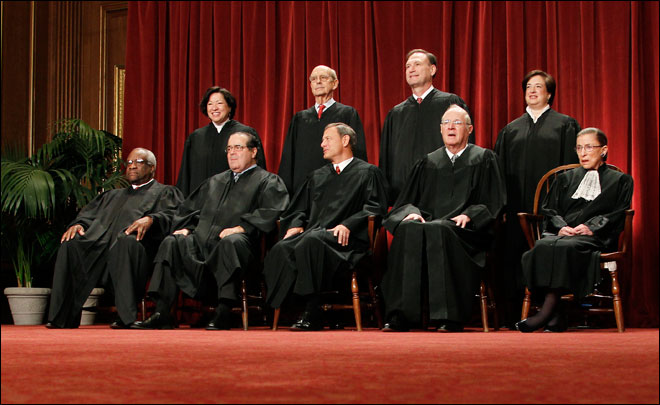
SCOTUS: the class of 2012
ACCORDING to the liberal-lawyer American Constitution Society, the future direction of the Supreme Court depends very much on who wins this year's presidential election.
A court with an agenda has many judicial techniques available to implement it, e.g. "stealth overruling" and "timebombs".
That's why the court's steep tilt to corporate and conservative causes is attracting media attention, with the Nation devoting an entire issue to the "1 Percent Court"; more here andhere. 
*   *   *
SALIM Hamdan's appeal of his military commission conviction has been decided by the DC Circuit. 
The now-repatriated Yemeni argued that Material Support of Terrorism (MST) is not a recognised war crime, and not surprisingly, judges independent of the Pentagon had no trouble finding MST - invented by Congress in 2006 - did not exist in 2001, when Hamdan was supposed to have committed it. 
Michael Dorf comments.
The case was long-delayed and meddled-in by the Pentagon at its Court of Military Commission Review (see my post of June 29, 2011) before reaching the circuit court. Once it got before a proper Article III federal court, even one consisting entirely of Republican appointees, MST was doomed. 
There's more on this important case here, here and here.
The companion appeal from the CMCR, Al Bahlul - a conviction for conspiracy - is still pending and will be rebriefed in light of Hamdan.
Kevin Jon Heller convincingly argues that the decision in Hamdan II will also doom conspiracy as a war crime.
David Frakt has more on Al Bahlul, his former client.
*   *   *
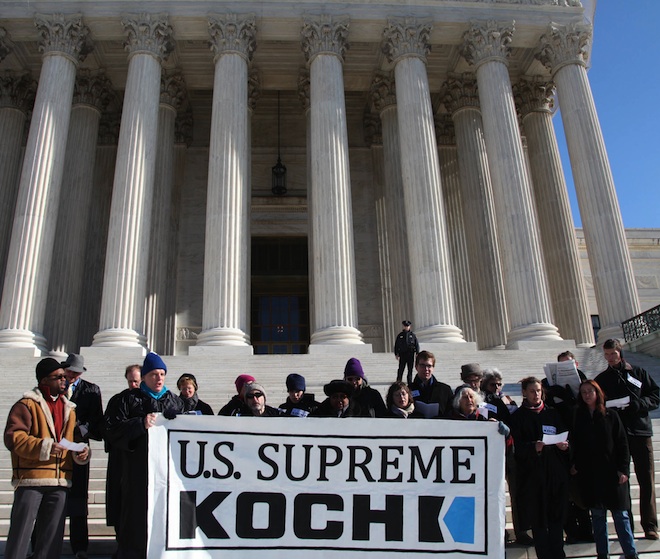
Court with an agenda
THE Supreme Court ruling in Citizens United - that corporations have a right to give politicians unlimited amounts of money from their corporate treasuries as a First Amendment right of free speech - is a gift that just keeps giving for the Republicans and their allies. 
ProPublica reviews the history of money in politics. 
Emboldened by the Citizens rationale, the US Chamber of Commerce is now attacking anti-bribery laws for allegedly infringing corporate free speech.
The greatest danger of Citizens United, however, may lie in state courts. 
The Atlantic has a series on the disastrous effect it is already having on elected judiciaries. More here and here.  
*   *   *
DC's senior district judge, Royce Lamberth, eventually sided with the Guantánamo Bar on maintaining access to their clients, but it hasn't all gone the lawyers' way: they're now reduced by Pentagon rules to 25 hours a week with their clients. 
Under George Bush they got 63 hours a week at Guantánamo. 
Perhaps more about the Pentagon's protocol for detainee lawyers will be disclosed in WikiLeak's latest release of prison camp policy documents.
In a separate revelation, the chief of the CIA's infamous world-wide abduction and torture program, sorry, "Rendition, Detention and Interrogation Program", has been identified as one Thomas Donahue Fletcher.  Remember that name.
The leaker, former CIA operative John Kiriakou, has pleaded guilty to a violation of theIntelligence Identities Protection Act.  
He'll serve 30 months in prison, but the more serious Espionage Act charges will be dismissed.  
It was the first successful IIPA prosecution in 27 years.
As fellow whistleblower Jesselyn Radack remarked:
"Kiriakou will become the only CIA agent connected with torture to go to jail, and he's the one who refused to commit it and condemned it publicly. Meanwhile, the people who ordered the torture, the lawyers who justified it, the torturers themselves, and the people who destroyed the videotapes of it are all ... free and unaccountable." 
*   *   *
GUANTÁNAMO prosecutors have backed off from their claim that all conversations of commission defendants are presumptively classified: now it's only their "observations and experiences". 
"Each of the accused is in the unique position of having had access to classified intelligence sources and methods. The government ... must protect that classified information."
As Opinion Juris wryly noted, the accused would have happily avoided the treatment they observed and experienced. 
"Unique access," indeed.

Thursday, October 4, 2012

From Roger Fitch and our Friends down under at Justinian


Epic injustice for child soldier

After 10 years at Guantánamo Omar Khadr is transferred to prison in Canada ... Convicted of a war crime for lawful actions against an opposing uniformed soldier in a war ... Perversion of the law of war ... Roger Fitch reports from Washington 
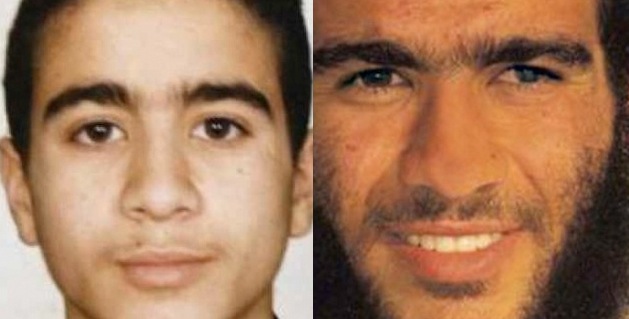
Omar Khadr: then and now
THE Guantánamo prisoner Omar Khadr has been repatriated to Canada, after more than 10 years of patently unlawful American detention. Here's a chronology of his life.
After a year of stonewalling, the Canadian government has agreed to the return of a citizen who is apparently the first person convicted in a military trial for simply killing an enemy combatant - an act that has always been regarded as lawful in war (see post of November 2010).
Omar Khadr's offences seem as much political as military.
In 2002, a child of 15, he found himself, at his father's direction, in an Afghan house that exchanged fire with US soldiers. He had little choice but to defend himself, but an American died.
That a Canadian should actively resist American soldiers offended both governments: he must be punished, and so he was sent to Guantánamo.
All "terror" detentions at Guantánamo have been unlawful, one way or another.
No prisoner has been provided the independent prisoner of war determination required by both the Geneva Conventions and the US Uniform Code of Military Justice.
All have been detained and/or treated in ways that violate multiple international treaties. Omar Khadr's case is one of injustice on an epic scale.
It's hard to know where to start.
First, he was a 15 year old boy caught in a war on his father's initiative. Both Canada and the US seem to have forgotten they are signatories to the "Child Soldier Protocol" that provides that children engaged in war should be regarded as victims whose rehabilitation is paramount.
While much has been made of Omar's purported status as a child soldier and the procedural unfairness of his military commission, what seems to have passed without notice is that he may be the first person ever convicted of a "war crime" for the classic act of war - killing an opposing uniformed soldier.
Khadr had a legal right to resist US attack in a war zone.
Not only did he have a right to self-defence, but, even if he was no more than a civilian who had taken up arms, he was perfectly entitled to shoot at soldiers (including a CIA operative unlawfully involved in the attack on Khadr's compound), so long as no treachery or illegal weapon was involved.
A grenade, which Khadr may or may not have thrown, is not illegal under the Law of Armed Conflict.
Did Khadr even throw the grenade that killed the US special forces soldier?  
The initial US military reports said that another defender who was shot in the battle had thrown the grenade.  But he was killed in the attack, and the report was changed to implicateKhadr, the only survivor.
In fact, the American soldiers may have committed war crimes in capturing Omar Khadr. He was shot twice in the back while badly injured, possibly unconscious, and hors de combat.
It's true that US medical care saved Khadr's life, setting him up for the first-in-history "murder" charges he later faced.
Those charges relied almost entirely on Khadr's "confessions", including the one he gave up under interrogation while lying gravely wounded on a stretcher.
Eventually Omar was taken to Guantánamo where, unlike other juveniles, he was given no special treatment or educational assistance, and held in brutal conditions no different from those of the oldest and most hardened terrorists, often in solitary confinement. 
*   *   *
AT Guantánamo, Omar was questioned by Canadian security officials and the information was shared with the US, a practice stopped by the Canadian courts.
Canada's Supreme Court strongly criticised the refusal of the government to intervene inKhadr's behalf, in violation of that country's Charter of Rights, but stopped short of ordering his repatriation, as a lower court had done.
Khadr was first charged in one of George Bush's executive military commissions but that system was thrown out by the US Supreme Court.
A new military commission was brought against Khadr under the statutory scheme introduced by the Military Commissions Act 2006, and he was charged with five "war crimes" variously unknown to the law of war (e.g. murder) or inapplicable to Khadr (spying).
As soon as the military judge departed from (Pentagon) script - by ruling favourably on a number of Khadr's motions - he was summarily removed, retired and replaced.
A more amenable Pentagon judge later ruled that all of Khadr's "confessions", even those made while wounded, would be admitted. 
Assuming Omar's actions were actually war crimes, these "confessions" would have been enough to convict him. 
His lawyers, like those of David Hicks, were forced to accept a deal involving a guilty plea for invalid crimes.
In pleading guilty, Omar Khadr was obliged to provide from his own mouth all the jurisdictional requirements necessary to sustain such a plea - had the charges themselves been valid. 
Part of the plea involved a diplomatic note from the Canadian government stating that it would be inclined to favourably review a transfer of Omar to a Canadian prison after he had spent one further year at Guantánamo. 
In fact, after that year, the Canadian government obstructed transfer for another year, so that it was not completed until September 28, 2012.
Khadr returns to Canada where over 60 percent of the citizens believe he is a depraved terrorist, incapable of rehabilitation and dangerous to Canadian society, a man unentitled to return to his own country.
Perversely, he's now a danger because he was "radicalised" by his mistreatment.
It's a sad victory for Omar Khadr.
Soon, however, he should be free, notwithstanding the six years of "sentence" he still faces in Canada.
Next year he will be entitled to parole. Should the matter be tested judicially, Canadian courts are unlikely to uphold convictions based on offences unknown to international or Canadian law.
Khadr could even receive an apology and compensation from the Canadian government.
After it allowed the US to render another citizen to Syria for torture, Canada had a formal inquiry, apologised to Maher Arar and paid him over $10 million. 
Omar Khadr deserves no less. 

Saturday, September 1, 2012

From Robert Fitch and our Friends Down Under at Justinian


The President's right to kill Americans

Clients at the Bay ... Everyone's getting tired of "targeted killings" by the "serial assassin" ... Brits pay compo to resident mistreated at Gitmo ... How to make cases go away ... DoJ drops Goldman Sachs prosecution ... Huge public disapproval of Congress ... Roger Fitch reports from Washington 
THE Pentagon wants to curtail Guantánamo counsel's access to their clients once they lose DC habeas cases.
See also and here. 
Lawyers are likely to learn new things, and it's inconvenient when they put to use what they learn. 
The government still claims every word a detainee utters is a secret, presumptively classified from the moment spoken.
It's a contention presently being contested by the ACLU in Guantánamo's "9/11" trial. 
The Pentagon worries that talk about rendition and torture, sorry, "detention and treatment," could cause "exceptionally grave damage".
Quite so: to the government and its staged military prosecutions. 
To be on the safe side, the Obama administration now claims the bare right to counselexpires after habeas cases are adjudicated. 
The New York Times called the action unconstitutional, and a disapproving op-ed appeared in the Washington Post.
DC Chief Judge Royce Lamberth heard the matter and seemed unpersuaded by the government's arguments.
All of the lawyers have security clearances (so do 4.8 million others in the US), so what's the problem? 
*   *   *
AMERICANS are still trying to get their heads around their president's claim that he has a right to kill them.
The LA Times is fed-up with these "targeted killings", which have a long and sordid history.
In Congress, even the bloodthirsty members want to see Obama's "licence to kill", i.e. the legal opinion supporting the killing of Americans overseas.
Repeated congressional demands for the document have been ignored by Attorney General Eric Holder.   
Jimmy Carter has effectively called President Obama a serial assassin, a view that shockedLawfare's Ben Wittes.
Some US states have murder offences that apply to killing with "depraved indifference" or"extreme indifference for human life".  One example is the law being applied in Colorado to the movie theatre shooter.
These laws are typically applied to acts of firing at random or into crowds - not unlike what happens to mourners at funerals in Afghanistan and Pakistan, apparently being targeted by Obama's assassination program.
Maybe there's a need for a federal "depraved indifference" law to apply to the killing of such civilians, including Americans, often in places where there's no war to which the US is a party, e.g. Yemen (there's  a good discussion of Yemen here). It might also make a worthy addition to the Geneva Conventions.
Meanwhile, an Afghan who says his relatives were unlawfully killed in a case of mistaken identity is suing the British government for its role in compiling faulty "kill lists" for US strikes in Afghanistan.
*   *   *
THE UK police are set to investigate British resident Shaker Aamer's mistreatment atGuantánamo.
He's the last UK-connected prisoner, and has already received a reported £1 million pounds from the UK government in settlement of his civil claims of British involvement in his mistreatment.
Helpfully, the head of Britain's MI6, Sir John Sawers, has publicly confirmed that his agency's equivalent in the US resorted to torture.
Another blunt admission has come from the State Department legal adviser, Harold Koh, who recently referred to Guantánamo as a place where the US - perhaps unwisely - had clapped "enemies of the state."  
Ben Wittes was shocked, again.
Nowadays, few people recall that in the 1980s the Yale law professor Harold Koh led the attack on George Bush, père, when Gitmo was first used for illegal detentions - of Haitian boat people (see my post here).
*   *   *
KILLING and torture aside, Senate Democrats have been considering a proposed Due Process Guarantee Act that would  limit the ability of the president to use the "Homeland Battlefield" provisions of the NDAA 2011 Act to seize Americans in the US and hold them indefinitely under military detention. 
The Senate has just released the record of the hearings, which sparked testy exchangesbetween Democrat Senator Al Franken and a surprising Republican witness, the odious Stephen Bradbury.
Bradbury, the Bush Justice Department's long-serving head of the Office of Legal Counsel, wrote some of the most egregious and shocking memos authorising torture. 
*   *   *
DEMOCRATS in the Republican-controlled House have introduced a Bill requiring judicial scrutiny of executive claims of state secrecy.
Another government tactic for making cases go away is to sit on prosecutions until the statutes of limitation run, as Mr Obama's DoJ did for prosecution of the Bush administration's torture crimes, and their subsequent cover-up (see my post of December 12, 2010).
There's a pattern of good-timing in the publication of the confessional memoirs of George Bush, Dick Cheney, the CIA's José Rodriguez and other torture figures from the Bush Regime.
The books have conveniently appeared after the S/Ls for their admitted offences expired.
The 2007 bank frauds are the latest controversy involving limitations. They're subject to a five-year statute, and the Securities and Exchange Commission is rushing around investigating them at the moment, ostensibly to prepare charges before the statute runs - although it must be said, this talk also provides a powerful incentive for timely contributions to the Obama re-election campaign. 
Sometimes it isn't necessary to run out the statute of limitation.
Using prosecutorial discretion, DoJ has decided not to prosecute Goldman Sachs for its well-documented leading role in the fraud behind the not-quite-over Global Financial Crisis. Seealso here.
Government lawyers still find time to prosecute Goldman Sachs employees accused of wrongdoing that injures the bank as opposed to, say, shareholders, American cities, their pension funds, or the public.
*   *   *
IN one of the most important appellate decisions of the summer, the Court of Appeals for the Armed Forces has ruled, in US v Ali, that it is constitutional to subject military contractors and other Pentagon camp-followers to military jurisdiction.
It's an important decision, since US civilian courts have lately granted immunity to the contractors, even when torture is involved.
*   *   *
THE unedifying spectacle of prominent American politicians - mostly Republicans - supporting the Iranian terrorist group MEK continues (see my post of January 18, 2011). 
The apparent immunity of these politicians from the legal consequences of their material support seems to fly in the face of Holder v Humanitarian Law Project, the 2010 Supreme Court decision that found even legal advice to terrorist groups was suspect (see my post of June 22, 2010). 
Perhaps it helps explain the latest Gallup Poll on Congress's performance. 
It shows public approval of Congress has now fallen to 10 percent. 

Sunday, August 26, 2012

David Remes' at Gitmo


LAWFARE

David Remes on His Latest Trip to GTMO

By Benjamin Wittes

Sunday, August 26, 2012 at 9:34 AM
David Remes, who represents several Yemeni clients at Guantanamo Bay, writes in with the following reflections on his latest trip to Guantanamo:
David Remes’ Latest GTMO Adventures
I returned from GTMO on Thursday, unexpectedly soon. I had flown down on Monday for an extended visit, but the visit was cut short when I and others were evacuated in the face of the threat from Tropical Storm Isaac.
A surreal flight back
We boarded a chartered commercial jetliner, bound for Andrews AFB, which is how the military ferries habeas lawyers and individuals associated with military commission cases to and from the base. On board were members of families of 9/11 victims, military commission judges and officials, commission prosecutors and defense counsel, translators, and, at the very rear, NGO observers and the media, and me. Aptly, all involved in this sad drama, except the detainees themselves, were bound together in this self-contained reality.
Before the cabin door was closed, crew members came down the aisle and told those of us in the last 34 rows (the media, observers, and me) to relocate to empty seats further up, to make room for a contingent of prisoners. We were incredulous, but we had heard this from the crew, and we anticipated a spectacle. Journalists began twittering and unpacking recording devices. I planted myself in row 33, expecting to see some of my clients. After about 15 minutes, crew members returned to tell us that it was all a misunderstanding and we could return to our original seats. 
Quis custodiet ipsos custodes?
As usual, in my two days of client meetings, I had an escort, courtesy of the Joint Task Force. Habeas lawyers must be escorted at all times. Commission lawyers, by contrast, may roam at large. This time, however, my escort had an escort – an Army Legal guy – presumably to keep the escort on his toes.
Someone must have instructed the Army guy never to let me out of his sight. A literalist, he trailed me everywhere – into the Subway’s, into the McDonald’s, and even up and down the aisles of the NEX, the base’s supermarket. He was never more than 10 feet behind me. He stood close by when I was at the magazine rack in the back picking magazines for my clients.
The incredible shrinking meeting schedule
In the two days I spent with clients at GTMO this week, I spent the maximum time currently allowed – 5 hours a day. In the beginning, however, when lawyers started visiting the base post-Rasul, they were allowed to meet 9 hours a day, seven days a week – a weekly total of 63 hours. See Shayana Kadidal, “Confronting Ethical Issues in National Security Cases: The Guantánamo Habeas Litigation,” 41 Seton Hall L. Rev. 1397, 1409-10 & n.50 (2011) (final proof). Today, a lawyer can work only 5 hours a day, as noted, and only 5 days a week – a weekly total of 25 hours.
Let’s not go all the way back, though, but instead start with the January 2008 schedule. Under that schedule, a lawyer could meet with clients 6.5 hours a day (9 am—11:30 am and 1—5 pm) five days a week – a weekly total of 32 hours. But we were also allowed meetings on weekends, if we had a good reason, and during lunch and prayer times. A lawyer working a seven day week could easily clock 42 hours. We took the 5:30 pm ferry back to the leeward side of the Bay, where we live, allowing us time to shop for dinner at the NEX before leaving.
(Actual meeting time under the January 2008 schedule was less than 6.5 hours a day, due to the time we lost passing through the security checkpoint; hassling over what papers we might bring into our meetings; waiting for the guards to bring clients to the interview sites and then “secure” them; getting ID badges, and simply being driven around.) 
A new schedule, issued in April 2011, cut our meeting time from 6.5 to 5 hours a day. So it has remained. The current boundaries are 9:15 am—11:30 am and 1:15 pm—4 pm. We are not allowed to meet with clients on weekends or during lunch or prayer times, leaving us just 25 hours a week for client meetings (assuming no slippage), versus the original 63 hours per week. We must also take the 4:30 ferry back to leeward, leaving no time for counsel and translators to shop for dinner. 
The current schedule is the current commander’s idea of reasonable client access under the protective order that in GTMO habeas cases since 2004. I shudder to think how he might exercise his discretion under the Memorandum of Understanding (MOU) that the government is now trying to foist on detainee lawyers and their detainee clients. At least the protective order is supervised by the court. The MOU makes the commander a law unto himself. 
Links to Lawfare’s excellent coverage of the protective order/MOU dispute are provided here.

Wednesday, June 27, 2012

From Roger Fitch and our Friends down under at Justinian


Election year show trials
Monday, June 25, 2012
Justinian in Citizens United, Drones, Guantanamo, Habeas, Khalid Sheikh Mohammed, Roger Fitch Esq
US Supremes summarily dismiss review of Citizens United ... Judicial appointments frozen ... Obama's drone frenzy makes him "hit-man-in-chief" ... Guantánamo trials seek to neuter Republican bellicosity ... The sham of habeas hearings ... Our Man in Washington reports 
Obama: launched six times as many drones as "lawless yahoo Bush"
IT'S an election year, and Mother Jones has a handy list of how much a seat in Congress will cost you.
These calculations are not mere cynicism, as the 2010 Citizens United decision of the Supreme Court has made unlimited corporate money the essential medium in US elections.
Now the Supreme Court's conservative majority has just dismissed in a single paragraph attempts by Montana, or any other state, to impose restraints on corporate election spending. 
Meanwhile, the lower courts remain clogged with around 70 judicial vacancies remaining to be filled.
As always happens with an approaching presidential election, the opposition is blocking all judicial appointments -in this case, it's the Republicans, confident that a President Romney will appoint only ideologues and "movement conservative" judges fully responsive to corporate and party wish lists.

As for the 2012 presidential election, it's shaping up as a terrorist-killing competition between Romney and Obama, a quest for "Assassin-in Chief".

Mr Obama is presently unsurpassed at killing.
Leaks to the NY Times show his prowess at personally approving those selected for terrorist immortality, in a "war" whose very existence many question.
Inevitably, a fair number of innocent civilians will be called upon to join the handful of terrorists in the Islamic hereafter - far more than the number of innocent American civilians killed by terrorists each year - 17 in 2011, 15 the year before.
At last, a quiescent media is taking notice of Mr Obama's refined taste for assassination.
The Guardian is calling it the "normalisation of extrajudicial murder", while a Miami Herald writer has described Obama as the "hitman in chief " who has launched six times as many drones as "the lawless yahoo Bush".
The target list conveniently includes anyone likely to get hit. Unless proved otherwise later (i.e. after death), all "military age males" in a strike zone are presumed to have been targetable "militants", and if there are children among them, the Pentagon has a ready excuse in the "adult-sized child". Glenn Greenwald has more.

In the ultimate Catch-22, dead civilians can only establish their innocence posthumously. 
Even the New York Times delicately ventured, it was "too much power for a president". 
The UN special rapporteur on extrajudicial killings has not shied from using the words "war crime".

A new book traces the journey of Mr Obama from Nobel Peace Prize laureate to Murder Inc. godfather. Gabor Ron and Daphne Eviatar of Human Rights First comment. 
*   *   *
Former Guantánamo prosecutor Mo Davis: the US has handed KSM all he wants - martyrdom
WITH such notches on his "terror war" belt, Obama the "national security" enthusiast has travelled so far to the right that there's precious little room for Romney to manoeuvre.  
An important ploy in the marginalisation of the Republican remnants will be the Guantánamo show trials.

The trials are about to resume at Guantánamo, with the arraignment of Khalid Sheikh Mohamed and the 9/11 Gang, even as the commissions' doubtful constitutionality is being considered by the DC Circuit.  
The KSM trial is being called the trial of the century.
Nominally, these trials remain "military commissions", though few charges have had any connection to military offences.
Nevertheless, as the apostate former Chief Prosecutor at Guantánamo, Morris Davis, notes, the US has handed KSM all he wants with a wonderful propaganda trial by an illegal tribunal, leading to his glorious martyrdom by lethal injection.
The confessed mass-murderer will die a "warrior", though nothing he has done occurred in any US war. 
A gratified KSM, adopting the government's classification of him as a "warrior", is now demanding the right to wear a military-style uniform at his trial. 
KSM's judge, US Army Col. James Pohl, is no doubt mindful of the fate of the original judge in Omar Khadr's military commission: when Judge Peter Brownback strayed from the Pentagon script, he was summarily removed and retired in a matter of days (see my post of June 2, 2008).   
There's already a defence motion to remove Judge Pohl from the Abd al-Rahim al-Nashiri case, which he is also hearing.
After six or eight years of pretty much ignoring Guantánamo's system of military justice for "terrorists", the press has suddenly come alive with the arraignment and ongoing pre-trial motions of Nashiri, alleged to have been the ringleader of the USS Cole bombing (formerly, merely an "unindicted co-conspirator").

Professor David Frakt has a piece on the double standards involved in assassinations and commissions and has also written on the pretend nature of the alleged offences.
Nashiri's actions come closest to qualifying as a valid war crime, except there wasn't a war in Yemen in 2000.

As David Glazier, another dissenting law professor has observed, the particular charges against Al Nashiri are logically impossible as there was no war and making it a war offence only increases defences available to the defendant, perhaps even creating insurmountable obstacles to a successful prosecution.
*   *   *
Judge Brown: white-ant
I PREVIOUSLY reported the rearguard action of partisan Republicans on the DC Circuit, bent on blocking the implementation of the 2008 Boumediene case. 
Several judges have white-anted the precedent or spoken out against the case, e.g. Janice Rogers Brown, perhaps the most shrill Republican on the DC Circuit. 
A new Seton Hall University study shows that court-mandated constitutional habeas hearings have become a sham as district court judges have been routinely overruled by the DC Circuit using novel reasoning to usurp the district courts' authority. 
To be sure, administration apologists such as Lawfare's Ben Wittes dispute the record. 
The Congressional Research Service has just updated its definitive summary of current detainee law.
Now the Supreme Court has sided with the DC Circuit, effectively repudiating the groundbreaking Boumediene decision.
The court has rejected without opinion all seven detainee habeas denials (now eight) appealed from the DC Circuit, plus the civil suit of Lebron/Padilla v Rumsfeld.  Scotusblog has more.

The NY Times called it a "retreat" and the LA Times, "bad judgment". Emptywheel headlined its story, "SCOTUS kills habeas corpus".

It's a significant setback for the rule of law, no matter who wins the next election and what changes occur in the composition of the court.
Marjorie Cohn and Steve Vladeck comment.

The unrepentant DC Circuit quickly added to the despair by its decision in the case of Doe v Rumsfeld involving a US citizen who says he was detained and mistreated by the US in Iraq.
The DC panel had no problem with that as long as it was a "war zone".

Jurist has more.

Nevertheless, the Abu Ghraib torture case has gone against corporate mercenaries in the newly progressive 4th Circuit. More here. 
Prof Vladeck, the token progressive at the terror-hysteric "national security" website Lawfare, has more.
Article originally appeared on Justinian: Australian legal magazine. News on lawyers and the law (http://www.justinian.com.au/).
See website for complete article licensing information.

Friday, March 16, 2012

From Roger Fitch and our friends down under


The Monte Cristo syndrome

Guantánamo: give evidence against other prisoners and we might let you out, one day ... As long as you're not too angry ... The new prosecution paradigm and the latest stitch-up ... Plus, the legal basis for drone killing of Americans without due process ... Roger Fitch - Our Man in Washington 
"Farcical judicial trials conducted by us will destroy confidence in the judicial process as quickly as those conducted by any other people ... there are certain things you cannot do under the guise of a judicial trial. Courts try cases, but cases also try courts." US Supreme Court Justice Robert Jackson, Chief Prosecutor, Nuremberg Tribunal. 
*   *   *
"Robert Jackson ... would turn over in his grave if he knew what was going on at Guantánamo." Henry King, Jr., Associate Prosecutor, Nuremberg. 
*   *   *
The first new military commission prosecution was recently announced, against the Pakistani Majid Khan. A plea bargain quickly followed. If all goes well, Mr Khan, held without charge since 2003, will be sentenced in 2016. Is that speedy, or what?
The media were mostly cock-a-hoop over the prospect of new "war crime convictions," even though Khan, like the all the other people charged in commissions since George Bush first set them up in November 2001, will not stand convicted of any crime actually applicable to him under the law of war. 
As Melina Milazzo, counsel for the Law and Security Program, noted:  
"The US military commission system, now in its third incarnation, faces lengthy litigation over the legality of trying individuals for offenses that do not actually constitute war crimes, the potential ex post facto problems with prosecuting conduct not considered criminal until the passage of the Military Commission Act, and the scope and meaning of the rule and procedures applicable during trials." 
Khan, who finished school in Baltimore, is the only Guantanamero with American resident status. 
He's a client of the Center for Constitutional Rights, which noted: 
"Majid Khan is unique among Guantánamo prisoners in two important respects. First, he has long had legal status in the United States, as well as other substantial, voluntary ties to this country, which vest him with full constitutional rights. Second, in March 2003, he was captured and forcibly disappeared by the United States. There is no serious dispute that he was abducted, imprisoned and tortured by US officials at secret overseas 'black sites' operated by the Central Intelligence Agency before he was transferred to Guantánamo Bay in September 2006. Nor is there any serious dispute that Majid Khan's detention and interrogation violated US and international law." 
Just as it seemed the question of constitutional rights would be litigated, however, Mr Khan made a deal. 
In return for a finite sentence, Khan will plead guilty and testify against Khalid Sheikh Mohamed.
The theory is that, since KSM has been badly tortured, "clean" evidence is needed for use against him. 
Majid Khan: tortured evidenceOf course, Majid Khan has also been tortured in the same CIA dungeons, so it's hard to see the point of the exercise, other than taking the current issue of Khan'storture off the table.
It would make more sense to use people who haven't been tortured, to grass up those who have. 
In any case, there's a Pentagon offer to remove from its dubious indefinite detention list those Gitmo prisoners who "co-operate".
It's part of a strategy to get prisoners to testify against each other in return for "lighter" plea-bargained sentences, or simply better treatment while awaiting justice. 
It's a new era, where Guantánamo prisoners will have to denounce each other to save their lives, or at least escape lifelong extrajudicial detention. 
Under the new prosecution paradigm, commission defendants will have to confess to pretend war crimes if they want to go home. From now on, plea bargains, and coffins, would seem the only way out. 
The media have descended into interminable discussions as to whether sentences have been "light" or "heavy", while neglecting to inquire if the crimes actually exist. 
Wittes: terror savantThe fact that the "war crimes" don't, in fact, exist is not seen as a problem. Successive US governments have skilfully prevented court rulings on the validity of any of the charges.
Luckily, when a defendant confesses as Khan did and pleads guilty, there's no appeal.   
At the conservative Lawfare, resident bush-lawyer and terrorism savant Ben Wittes thought the Khan stitch-up was great, and the Washington Post agreed.
The Atlantic and the Times, however, were not impressed, nor were the ACLU and Human Rights Watch.
*   *   *
The National Defence Authorisation Act, with its facility for military detention of civilian "terrorists," has only just passed (see January post), but signs of its intended use are already emerging. 
In DC Circuit appeals, the government is using the NDAA provisions to change the rules onhabeas for Gitmo prisoners.
Both the conservative New American and more liberal Arab American News are appalled.
Scotusblog has the latest update on the status of Gitmo habeas appeals.
*   *   *
Pentagon's Johnson: drone strikes are legalThe government claims it's adhering to law in its lethal drone strikes.
Pentagon General Counsel Jeh Johnson spoke at Yale Law School defending the aerial assassinations in a speech reviewed by Gabor Rona and Emptywheel. 
Attorney General Eric Holder followed-up Johnson's speech with an address at Northwestern Law School, setting out for the first time the legal basis for intentionally killing Americans without due process.
Georgetown law prof David Cole was highly critical of Holder's performance, and even the conservative Washington Times was shocked by the attorney general's assertion of an exclusively "presidential" due process.
*   *   *
Literary allusions have been used to analyse Guantánamo: Kafka's The Trial, and 1984.
The latest one explains the peculiar reluctance of the Pentagon to release a single innocent person from Gitmo. 
Dumas: unknown war crimes will do the trickThe Count of Monte Cristo effect cuts in when a person is thevictim of an outrageous miscarriage of justice. 
Readers of the classic novel by Alexandre Dumas will remember the vengeance of the innocent man unhinged by his shocking mistreatment.
Torture, humiliation and years of extrajudicial imprisonment - followed by sham trials for newly-invented crimes - will usually do the trick.
In the case of the "convicted terrorist" Omar Khadr, held at Guantánamo since his 2010 plea deal, there's also the palpable bad faith of a Canadian government that has failed to bring him home since he became eligible for repatriation last October.  
A fear of the Monte Cristo syndrome must be behind some Canadians trying to block Khadr's scheduled repatriation: they've got a psychiatrist who says Omar is "full of rage" over his treatment at Guantánamo.
Even if he wasn't a danger to Canadian society before, he is now.
Now that's a Catch-22.