Monday, May 13, 2019

From Our Friends Down Under at Justinian...

The Obstructionist-in-Chief

Three Pinocchios for Billy Barr ... Mueller's 11 obstruction findings ... Charging and indicting Trump ... SCOTUS takes on cultural issues with new term cases ... Invalid orders of a compromised military commission judge ... Noam Chomsky on how the US political system works ... From Our Man in Washington, Roger Fitch 
"[It's] unlikely that President Trump is a recruited and controlled source of the Russian intelligence services ... Yes, he is a cauldron of potentially exploitable vulnerabilities. He is greedy, has lax morals and shame, isn't particularly patriotic, has a difficult time with right and wrong and is easy to manipulate. He would be easy to exploit and entice into ... a conspiratorial relationship [but] ... impossible to control. His narcissism, poor memory and ego would make it all but impossible for him to follow directions and keep a secret ... He blathers about things he doesn't understand, never admits that he is not an expert, is loathe to admit mistakes, lies constantly and is barely intelligible ..." - John Sipher, CIA's former head of Russian operations.  
IN his full report, Special Counsel Robert Mueller found no legally-culpable Russo-Trump conspiracy (many questions remain unanswered) but there was evidently collusion in the shared objective of electing Trump, quid pro quo or not. Also, AG Bill Barr's gratuitous prequel - pre-emptively acquitting Donald Trump of obstruction - now seems the act of a Nixonian Attorney General.
Barr has form for suspicious redactions of  DoJ memos, and the Washington Post Fact-Checker gave his pre-Mueller epitome Three Pinocchios.
The Attorney-General misrepresented Mueller's report in important ways.  Chief among them was implying that Mueller found no obstructions of justice. In fact, Mueller found eleven potential obstructions and asserted his belief that presidents could be charged with obstruction (their lawyers should also be concerned), but he made no prosecutorial recommendation. More here.
It seemed an "indictment in all but name", with a smoking gun, but Mueller stopped short of a formal finding of obstruction, on the circular grounds that, under DoJ ruling opinion, Trump could not be legally indicted, and recommending charges would thus be "unfair". Some strongly disagreed, including 650+ ex-federal prosecutors.
The report would have sunk any other president, but Trump remains standing, though under investigation in the Southern District of New York, among other places.  
Even if the Russian conspiracy fizzled, the report provided an impeachment referral, an obstruction "road map" that Barr tried to conceal.
The subject of this attention, serenely unaware of the constitution's impeachment provisions, moved on to the obstruction and stonewalling (more here) of congress, where Democrats aren't doing much anyway.   
*   *   * 
SCOTUS: the columns are Corinthian 
The last cases of the supreme court term were argued in April, including the important census and agency deference disputes. The court heard, and appeared ready to uphold, the "separate sovereigns" exception to the Constitution's double jeopardy clause. 
Cases already decided include Lamps Plus, another anti-worker pro-business arbitration ruling by the politically-divided court.
In its next term, the newly-remodelled supreme court will take on cultural controversies, e.g, whether sex discrimination includes LGBT rights, a hot textual topic for the "originalists" Gorsuch and Kavanaugh. 
The president must "faithfully uphold the law", but in a 5th circuit appeal, Trump's DoJ has changed sides to defend an off-the-wall Texas federal court decision declaring Obamacarewholly unconstitutional. 
The 2nd circuit is considering Trump tweets, with the president asserting a right to bar uncongenial tweeters from his Twitter site. 
The conservative 6th CA has joined other circuits, striking down appalling partisan gerrymanders in the Trump heartland of Michigan and Ohio.  It's a constitutional breakthrough that may not last.
*   *   *
Department of Justice, Washington: with protesters
Hopefully, some readers will have heard about a "no good, very bad day" for Guantánamo's military commissions, when the DC circuit threw out 460 written orders of a MC judge who presided over a case staffed and funded by the Justice Department, while he concealed, with prosecution assistance, his concurrent negotiations with DoJ for an immigration judge position.
Lawfare and Noah Feldman have more on the latest failure of the Pentagon's simulated justice. 
Other points of interest:
*   *   *
Chomsky the Younger: how Republican politics works 
For those who wonder how Republicans prosper and endure under "a mendacious narcissistic bigot who lost the popular vote by 3 million votes", Noam Chomsky has a convincing explanation: 
"Republicans face a difficult problem. They have a primary constituency [of] extreme wealth and corporate power. That's who they have to serve ... You can't get votes that way, so you have to do something else to get votes. What do you do to get votes? This was begun by Richard Nixon with the Southern strategy: try to pick up racists in the South. [In] the mid-1970s ... Republican strategists hit on a brilliant idea. Northern Catholics voted Democratic ...  a lot of them working-class. The Republicans could pick up that vote by pretending ... to be opposed to abortion. By the same pretence, they could pick up the evangelical vote ... You go back to the 1960s, ... [t]he Republican Party ... position was: Abortion is not the government's business ... They turned almost on a dime in order to try to pick up a voting base on ... cultural issues.
Same with gun rights. Gun rights become a matter of holy writ because you can pick up part of the population that way ... [They] put together a coalition of voters based on issues ... the establishment ... don't like ... 
And they've got to hold that, those two constituencies, together. The real constituency of wealth and corporate power, they're taken care of by actual legislation ... lavish gifts to the wealth and the corporate sector - the tax bill, the deregulation ... Meanwhile, Trump has to maintain the voting constituency, with one outrageous position after another that appeals to some sector of the voting base. And he's doing it very skilfully." 
Postscript: Trump will pull out of the Arms Trade Treaty limiting trade with terrorists. The troubled NRA, an organisation more terrorist than charitable, according to NY's AG, doesn't like it. 

Friday, March 15, 2019

From our Friends down under at Justinian

A light sprinkle of good news


The search for Trump's worst cabinet member ... Environmental plunder ... Court stacking under Mitch McConnell ... Rupert Murdoch's Fox News props-up Trump's Roman circus ... Yet, amid the debauchery there are tiny rays of hope ... Some significant decisions from a stacked SCOTUS ... And women out west take control of state legislatures ... Roger Fitch reports from Washington 
"Murdoch regarded Trump with disdain, seeing him as a real-estate huckster and a shady casino operator.… but he was a visionary about the niche audience that became Trump's base" - New Yorker
"Murdoch didn't invent Trump, but he invented the audience. Murdoch was going to make a Trump exist. Then Trump comes along, sees all these people, and says, 'I'll be the ringmaster in your circus!' " - Reed Hundt, Clinton FCC chairman
"Trump serves as a carnival barker for Fox" - Blair Levin, former FCC chief of staff
HE may be embroiled in the biggest political scandal in US history (more here and here), but President Trump still clings to power, sweating out the results of the Mueller Investigation.  
Fresh reports of Trump's egregious misconduct regularly appear and, just in time for congressional subpoenas, the Brookings Institution has a 2nd edition of its voluminous report on his obstructions of justice. Ethics watchdog CREW has a report on campaign finance malfeasance. Just Security meanwhile is tracking Mr Trump's damage to democratic norms.
The heat intensified in February, when Trump's former lawyer, Michael Cohen, testified before US House and Senate committees.
Among Cohen's revelations: Donald Trump never expected to win nomination or election, but saw the campaign as a marketing opportunity ("infomercial") for his properties, especially his project to build Europe's tallest tower in Moscow, to be named, naturally, after himself. It's a brand name now toxic. 
Following Cohen's house testimony, the House Judiciary Committee issued sweeping document requests (sorted by category here and here).
The Democrats will shortly demand Trump's tax returns. The president is already hiring teams of lawyers to assert executive privilege in this and other matters, many likely to reach the supreme court.
One of Trump's lawyers, the onetime Mafia Commission Trial prosecutor Rudolf Giuliani, knows better than most the ins and outs of organised crime. Ironically, his trademark techniques for taking down the Mafia could now be employed against Trump and the Trump Organisation. 
The president does have one enormous advantage. The New Yorker has an in-depth reporton how Rupert Murdoch's Fox News has become integral to White House messaging, essentially maintaining the rage of Trump's dwindling base as the walls close in and Foxexecutive Bill Shine, parachuted last year into the position of White House Communications Director, is now moving on to advise Trump's re-election campaign.
*   *   *
A subsidiary of the US chemical industry
After the departure of most of Trump's original crew, there's a new competition for his worst cabinet member. 
An obvious choice might be CIA director Gina Haspel, former commandant of CIA torture camps in Thailand, and possibly Guantánamo. Though the subject of a criminal torture complaint overseas, she's been praised for bringing new people - especially women - into CIA leadership positions. 
Nothing good is said, however, about the self-dealing Commerce Secretary Wilbur Ross(more here) or the scandal-ridden Labor Secretary Alexander Acosta.  
There is also nothing positive about the new EPA Administrator from the coal industry, Andrew Wheeler. The Trump administration's environmental policies remain shamelessly corrupt, with toxic chemicals deregulated, and the EPA transformed into a virtual subsidiary of the chemical industry. 
Under the administration's cynical cost-benefit analysis, 11,000 extra deaths a year is a price worth paying to relieve industrial polluters from the "burden" of mercury emission regulations. More here.
The administration has even rolled back the modest and sensible regulations of oil and gas exploration that were introduced after the Deepwater Horizon spill in the Gulf of Mexico, the worst such catastrophe in US history.  
Scientific advisers are meanwhile banished from positions with the EPA and the Interior Department (report), despite a damning new history of the failure to take action on climate change.
It's all part of a pattern: the Trump administration, like its corporate sponsors, has pragmatically decided that the planet is doomed and it's too late to do anything, anyway - except loot what's left.
*   *   *
McConnell: bench stacker extraordinaire
The US House may be busy bashing Trump, but nothing will happen in the senate so long as the intensely partisan Mitch McConnell remains Senate Majority Leader.  
McConnell is personally credited with packing the federal judiciary, beginning with the supreme court itself, where Republican loyalists have since signed off on Trump's "Muslim ban", and seem prepared to green-light the illicit motives underlying "national security" declarations, and such recent Trump initiatives as the rigged census questionnaire; the immigration "national emergency"; and an Army-built border wall.
If the courts rule against Mr Trump's national emergency executive order, will it make any difference? He recently openly flouted a federal court order striking down another executive order excluding aliens.
While the supreme court has unique internal dynamics, it is the lower courts that are suffering the most from McConnell's systematic stacking. Alarming appointees, chosen for conservative ideology, are being nominated and confirmed in droves; some are destined to be forever tainted as "Trump judges". 
One of the most unsuitable, Howard C Nielson, is a nominee for US District Court in Utah. Nielson once worked in the "torture memo" section of George Bush's Justice Department; his contribution was a 29-page memo implausibly (and wrongly) claiming that the 4th Geneva Convention only applied to those civilians detained on US territory, leaving US detainees in Afghanistan unprotected.  
*   *   *
The supreme court is nevertheless producing significant decisions.
In Timbs v Indiana the court cited the 14th amendment to incorporate one of the last elements of the Bill of Rights not yet fully applied to state and lower governments, the 8th amendment's protection against excessive fines, more here.  
Jam v International Finance Corporation opened international organisations (here, a subsidiary of  the World Bank) to civil liability for actions previously believed immune. 
The court also ruled the death penalty could not be inflicted on someone suffering dementia.
In a notable appeals court decision, Fazaga v FBI, the state secret defence was rejected by the 9th circuit. It was a refreshing change after the abuse of the doctrine under the Bush and Obama administrations, when it was not infrequently used to cover up criminal governmental and corporate misconduct. 
In a notable civil case that also survived "state secret" claims, one of the US-hired torture accomplices at Abu Ghraib, CACI International, will face trial at last, after a decade of stonewalling. Another contractor at Abu Ghraib, Titan Corporation successor L-3, settled with Iraqi plaintiffs years ago.
*   *   *
Not all the 2018 election news has been bad.  
Nevada has become the first US state where women hold a majority in both houses of the legislature, and women have taken control of Colorado's lower house. The West has historically led the way in women's participation in politics; this year Wyoming is marking 150 years of full women's suffrage, the world's first. 

Tuesday, January 15, 2019

From our Friends down under at Justinian...

Trump - Russia's man in Washington ... Unhinged, disordered, unfit ... More villains to walk the plank ... Buying elections and the gerrymander ... Conservative SCOTUS could make things worse ... Unqualified federal judges ... William Barr the new/old Matthew Whitaker ... Roger Fitch files from Washington 
"[H]is chief legacy is to have cast a serially bankrupt carnival barker in the role of a man who might plausibly become the leader of the free world" - New Yorker on the TV producer who cast Donald Trump in The Apprentice 
Almost daily, Americans receive fresh evidence of their president's disordered and dishonest mind, his disregard for law, his instinctive, compulsive mendacity.  
In a recent pleading, beleaguered lawyers at the Department of Justice felt obliged to claim President Trump's damaging tweets should be ignored because he doesn't know what he's talking about. Certainly no competent lawyer would find them advisable: some may amount to witness-tampering. 
Most of the criminal investigations threatening Trump and his circle - about 17 - involve Russians, and over 100 contacts between Trump's campaign and transition team and Russian-linked officials have thus far been reported.  
The president's vast array of legal and ethical problems involving corruption and malfeasance meanwhile grows exponentially. Finally, he's getting the attention he craves: everything bearing his name is under investigation, and some property could qualify for asset forfeiture under RICO, the Racketeer Influenced and Corrupt Organizations Act .
Perhaps, like Al Capone, Trump could end up in jail for tax evasion.  The Trump Organisation CFO Allen Weisselberg has received immunity and is cooperating with Special Counsel Robert Mueller. The Trump Foundation has surrendered, following an adverse court ruling allowing the NY AG's fraud case to go forward.    
Venality permeates Trump's businesses, foundation, family and cabinet, but the president carries on, as re-election may be his best hope of avoiding eventual indictment, more hereand here. Yet, even as the administration openly serves the material interests of Trump and his corporate friends, trouble is brewing.
With the new Democrat house, he faces a real risk of a (messy) impeachment. 
Trump has now lost two-thirds of his original senior White House staff, and cabinet firings and resignations, such as that of Interior Secretary Ryan Zinke, have damaged his government. Zinke was subject to 18 federal investigations, two more than the infamous EPA administrator, Scott Pruitt, forced out earlier last year; both men helped themselves while pursuing environmentally-disastrous deregulation.
Besides cabinet members who departed "under ethics clouds", the president has disposed of Secretary of State Rex Tillerson, who called him "a f**king moron" (Trump responded with "dumb as a rock"); parted company with White House Chief of Staff John Kelly, who reportedly said, "He's an idiot" and called him "unhinged"; and finally, ousted the last level-headed member of cabinet, Defence Secretary James Mattis. 
Al Capone: tax evasion may also catch Trump
Mattis credited Trump with "the understanding of a fifth or sixth grader", but he was being kind.
The Defsec's departure seemed the final straw for congress and America's allies, but as John Bellinger notes, even Republican national security boffins predicted Trump would be the most reckless president in American history.  
And dangerous: the Atlantic has a long read on the alarming arsenal of dictatorial powers Donald Trump has at hand, thanks to "national emergency" provisions passed by complacent congresses over the years. 
Two notable villains remain in cabinet: hapless Treasury Secretary Steve Mnuchin, possibly next for the plank, and Commerce Secretary Wilbur Ross, perhaps the greediest member of Trump's crooked crew. 
*   *   *
There's a preliminary report, more here, on the chaotic 2018 US elections. 
At $5 billion plus, this congressional cycle was the costliest in history. The predicted consequences of Citizens United, the 2010 supreme court case that tore away restraints on corporate interference in election funding, were apparent: an unparalleled outside intervention in American democracy that saw "independent" (non-party) spending rise from $200 million in 2010 to nearly $1.5 billion in 2016.
Divided governments were elected in badly-gerrymandered states, with legislatures remaining Republican while Democrats took over state offices such as governor and attorney general. The legislatures in four Republican-controlled states responded by going "full-on authoritarian". 
The latest dirty tricks against incoming Democrat office-holders are bringing the Republicans' preferred business model - cheating - to renewed public scrutiny, in a way diffident Democrats never did. 
Even so, one of the states, North Carolina, could become a functioning democracy again. There's hope that the NC Republicans' state district gerrymanders, concocted after the 2010 federal census, will be knocked out in time for the 2020 election and before a new federal census: in 2018, a  50 percent vote for NC Democrats resulted in just 23 percent of the US house seats. More here on NC. 
In Washington, the house Democrats' first priority is a bill to comprehensively renovate election law, but with new certiorari grants, the deeply-conservative supreme court could undermine gerrymander reforms and make things worse.  
There was one bright spot in the latest elections: the American discovery of preference voting. A Maine Republican lost his house seat under the state's new "ranked choice" voting, the first such victory in a federal election.
*   *   *
O'Connor (left): compliant, loyalist judge
Unqualified judges continue to receive important federal judicial appointments, e.g, to US Courts of Appeal. Some are scorned by the ABA, as they have tried few cases and can't write intelligible opinions.  
A few party loyalists already on the federal bench are contributing to Republican mischief, e.g, in Texas, where District Judge Reed O'Connor, appointed by G.W. Bush, accepted an "off-the-wall argument" that Obamacare is unconstitutional, simply because the mandate requiring people to have health insurance was repealed. More here.   
The decision is widely seen as partisan judicial activism: the judge is a favourite of Republicans who forum-shop for desired but politically-controversial rulings. 
O'Connor previously issued a number of orders against Obama initiatives and, in one startling decision, found that the 40-year old Indian Child Welfare Act, favouring adoptions by Native-Americans of their own kin, discriminated against non-indigenous Americans.  
*   *   *
Barr: a lot of time in the top paddock
Attorney General Jeff Sessions was also let go by Trump, in much the way the one-time reality TV star disposed of "losers" on The Apprentice. 
Replacing the AG offers Mr Trump another chance to hobble DoJ's investigation of Russian involvement in the 2016 elections, newly confirmed in two reports commissioned by a bipartisan US senate.
Trump's choice for acting AG, Matthew Whitaker, has long opposed the Mueller investigation he would be overseeing. The DoJ Office of Legal Counsel attempted to justifyhis appointment, but there was an ethics review. Whitaker then rejected his own department's finding that he should recuse himself from involvement in the Mueller investigation based on previous prejudicial remarks.
Now there's a nominee for permanent AG, bad as the old one, and it's sad news for Guantanameros: William Barr was AG for Bush père when the notorious internment camp was first set up.  Barr's anti-Mueller views are well known; last year he sent an unsolicited memo to DOJ arguing for presidential immunity from many criminal laws, including obstruction of justice.  

Friday, November 16, 2018

From our Friends Down Under.... at Justinian.

Race based vote gutting

Post mid-terms ... Trump toady takes over as AG ... Voter suppression in overdrive ... Racial tone to election rigging ... Roberts court heads off the "danger" of non-white voting ... Trump's election stunts ... From Roger Fitch ... Our Man in Washington 
THE US political climate remains dire following the elections. A venal authoritarian remains president, and the senate, America's own "unrepresentative swill", is still controlled by a dangerous political party ready to rubber-stamp appalling appointments to government agencies and federal courts.
Thanks largely to Republican gerrymanders, there was no "blue wave" in the US House (contra here), but Democrats managed to wrest control of it, while breaking the "death-grip" of their opponents on a number of state governments. 
A new level of Trump bad behaviour followed. Ominously, the president sacked his long-suffering attorney-general and replaced him with a controversial Trump loyalist who could stifle the special prosecutor's investigations, and even disclose to Trump the deliberations of Robert Mueller's grand jury. 
Fortunately, the timely release by the National Archives of the 1974 "Watergate Road Map" suggests a way forward for the special prosecutor, e.g. a report to congress, where a war is brewing: Democrats promise house investigations of their spectacularly corrupt president, while Trump threatens senate investigations of Democrats.
The senate could remain Republican for years, frustrating efforts to rectify the vote suppression, i.e. election fraud that enables minority Republicans to stay in office. Fortunately, 15 states had voting measures on their ballots this year, mostly to broaden the franchise, more here. 
The biggest rout of Republican representatives was in the Northeast, but there were gratifying results elsewhere, e.g. in southern California, where "Russia's favourite congressman", Dana Rohrabacher, was ousted after 30 years. 
In Wisconsin, Gov. Scott Walker was defeated, though the Republican legislature quickly began stripping the incoming Democrat of his powers; an identical phenomenon occurred in 2016 in North Carolina when another Democrat governor won in a Republican state. 
Having tightened the recount provisions in 2016, Walker had to come within one percent of his opponent to qualify for a recount. To considerable Schadenfreude, he finished 1.2 percentage points behind. 
Governorships were also "flipped" by Democrats in Nevada, New Mexico and Kansas, where America's leading vote-suppresser, Kris Kobach, was defeated. There were further pickups in Illinois, Michigan, and Maine, where Paul LePage, the "craziest governor in the US", retired.  
Voters fought back with initiatives, e.g. in Florida, where 1.4 million people with past felony convictions were re-enfranchised, and in Michigan where an anti-gerrymandering measure passed (there were other initiatives, some with sad results, and state constitutional amendments, e.g. in Alabama, where "fertilised eggs are now people").  
Democrat senators in Indiana, North Dakota, Missouri and possibly Florida were knocked out, but the party picked up senate seats in Nevada and (apparently) Arizona, leaving the Republicans with a net gain of two senate seats (Democrats are expected to lose a Mississippi run-off). 
In Florida, Democrats seemed about to retain Senator Bill Nelson, but the results were so close that the Republican candidate, the cadaverous Rick Scott, pulled ahead and a recount was ordered. Scott, the outgoing governor, instantly accused the Democrats, without evidence, of fraud. Significantly, Scott seemed intent on stopping, not just a recount, but the ongoing initial vote count. 
Swiftly changing demographics
Despite the vote suppression, the turnout of  an estimated 48.1 percent of eligible voters was far better than the 2014 midterm's 36 percent, where candidates could have won office with 18.01 percent of the eligible electorate.
The Democrats would have done better but for the voter-suppression tactics of the Republicans, put into shameless overdrive as the election approached, more here. 
While Republicans disingenuously claim the measures are necessary to prevent voting fraud, the real fraud is denying the vote. Rarely is the tactic reported for what it really is: a racist vote suppression program, cut from the same cloth as unconstitutional poll taxes. 
As a new book notes, whites have suppressed black voters from the moment the latter won significant rights to vote, but non-white voting now presents a demographic danger to Republican rule. It is this perceived existential threat that has led Republicans to embrace minority rule.
Such election fiddling first appeared in the 19th century in the hands of southern whites, but oddly, not in  1877, at the end of Reconstruction and the federal occupation of the South that followed the Civil War. It wasn't until 1890 that the South began systematically stripping African-Americans of their vote, a practice that continued until the adoption of the Voting Rights Act in 1965. 
Before 2000, no America state had a strict voter ID requirement. Then, in Crawford v Marion County (2008), the supreme court upheld a law requiring photo IDs.  
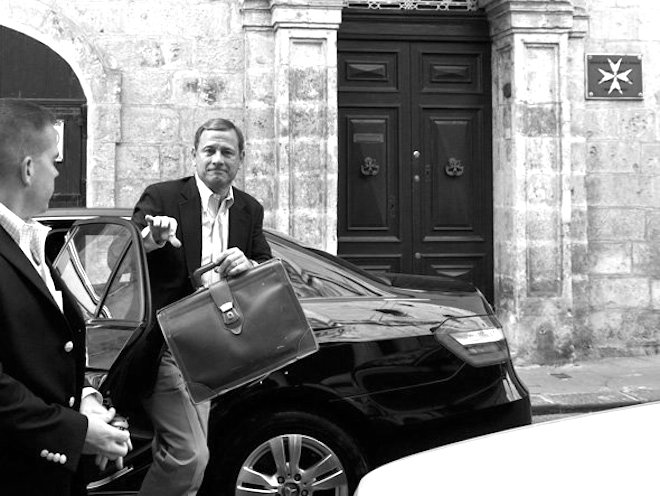
Roberts: vote gutting CJ
In Shelby County v Holder (2013), the Roberts Court gutted the VRA's recently re-enacted enforcement provisions requiring Justice Department pre-clearance of proposed voting laws in historically-offending states. 
Mere hours after the 2013 decision, the reconstituted confederacy (now including states like Indiana, Ohio, Kansas, North Dakota and Arizona) began deterring or preventing votes by those groups of people,  largely black or other minorities, seen as likely Democrat voters.
Shelby County v Holder is now seen as one of the supreme court's worst decisions, in a class with Plessy v Ferguson. In realising a long-held goal of hobbling Johnson's voting rights legislation, CJ John Roberts wrote that the VRA's essential pre-clearance enforcement section for bad-faith prior-offending states was no longer constitutionally warranted: racism was no longer a problem.
What followed Shelby County was a flood of new tactics, calculated, racially-motivated vote suppression schemes, conferring an advantage Republicans will still have when the 2020 census precipitates a new round of redistricting.
It seems to have been the successful partisan interference by Republicans in the razor-close 2000 election, culminating in the supreme court's Bush v Gore, that emboldened the party. 
Vote suppression will only get worse as Republicans try to stave off such apocalyptic, but inevitable, events as politically-suspect Latinos outnumbering "whites" in Texas, the second most populous state.  
*   *   *
One of Donald Trump's legally-dubious election stunts was to send thousands of US soldiers to Texas and the Mexican border. A probable violation of the Posse Comitatus Act, it was nicely timed to coincide with the midterm elections and intimidate (and deter from voting) Hispanic-Americans.  
Perhaps election interference, a real threat to "national security", should have prompted Bill Clinton to send federal troops (or national guard) to Miami on November 22, 2000. They might have quelled the election-changing "Brooks Brother riot", a faux demonstration by Republican staffers and operatives that prevented the recount of votes, giving Bush lawyers (including Brett Kavanaugh) time to get a temporary stay from a sympathetic supreme court justice.  
That order stopped the recount while Bush was ahead and the recount was never resumed, though it became clear afterwards that Gore actually won the popular vote in Florida, and thus the electoral college. 
The rest, as they say, is history.

Saturday, October 13, 2018

From our friends down under at Justinian....


An illegitimate SCOTUS

The US Supreme Court has been bought ... Long campaign to stack the court with judges favourable to corporate interests ... Huge lobbying and spending to secure Kavanaugh's confirmation ... Guns, God and presidential power ... The mid-terms and intensified voter purging ... From Our Man in Washington, Roger Fitch
"With Anthony Kennedy's retirement, there is no discriminatory voting restriction the justices will be unable to sanction, no immigration law born in animus they will be unable to approve, no expansion of corporate power they will be unable to accept, no grant of presidential immunity they will be unable to uphold, no financial or environmental regulation they will be unable to strike down, no religious objection to an antidiscrimination law they will be unable to recognize, no worker protection they will be unable to repeal, no limitation on abortion they will be unable to allow, and no abuse of power by law enforcement they will feel compelled to restrict" - The Atlantic.
The inevitable has happened. The US senate, unmoved by sexual assault allegations, the nominee's surly demeanour, and an open letter of opposition signed by over 2400 law professors, conferred a lifetime supreme court appointment on DC Circuit Judge Brett Kavanaugh.
A "movement conservative", Judge Kavanaugh is a Republican stalwart and former player in distasteful and highly partisan political operations. The party clearly believes he can be relied upon to bat away legal precedents standing in the way of party policy or the Republicans' hold on office (e.g, the coming troubles of Mr Trump), and his first case may offer him a chance to, uh, make a difference. 
At the supplementary senate hearings held following new accusations of youthful sexual assaults, Kavanaugh showed a palpable sense of self-entitlement, revealing an injudicious temperament, yet another cause for concern, including to the American Bar Association, who wanted to reopen its review of his qualifications.  
A snarling Kavanaugh lashed out at "the Clintons" and "left-wingers", ominously adding, "what's goes around, comes around". As it turns out, Kavanaugh's bad-boy drinking, woman troubles, and (perhaps calculated) senate counterattack have all been red meat for Trump's white male base in the lead-up to the November 6 elections.
Earlier hearings followed extensive legal blogging on Kavanaugh's judicial record and the likely consequences of his appointment; the senate focussed on his legal philosophy and attachment to precedent.
Conservative donors outspent liberals to influence the confirmation vote; corporate front groups keen to seat Kavanaugh spent $15 million. This was unsurprising; the nominee's double standard for corporations has already been the subject of a report by Public Citizen - more here.
By a happy coincidence, Judge Kavanaugh has a very broad view of campaign contributions, including those employed to place judges like him on state and federal courts.  
The supreme court was already lurching right, particularly after Trump's addition of the radical Neil Gorsuch, and Justice Kennedy's occasional departures from Republican party script usually involved social issues such as criminal justice or gay rights. Even if Kavanaugh had not succeeded, an equally odious justice would have been confirmed by the immoderate Republican senate.   
Although there is some suggestion that CJ John Roberts will provide a "swing vote", it seems more likely that an extreme far-right faction (comprising the CJ, Clarence Thomas, Joseph Alito, Gorsuch and Kavanaugh) will be in control for the first time since the early days of Franklin Roosevelt. All five of them lack legitimacy, in the view of the eminent law dean Erwin Chemerinsky. 
The Atlantic's Adam Serwer fears a return to the days of the 19th century "Redemption" supreme court; others worry that the court could be headed for the lawless laissez faire of the Lochner era, a business paradise where most social and economic regulation was constitutionally circumscribed. 
Some Democrats have threatened to impeach Justice Kavanaugh, and certainly a newly Democrat house of reps could investigate his misstatements to congress (and a lot more: Republicans are circulating a spreadsheet of potential unwelcome investigations if the Democrats "flip" the house in November). 
In the long run, there remains the option of "court-packing": FDR's proposed Judicial Procedures Reform Act of 1937, though never adopted, precipitated a salutary left turn on the court, enabling him to have his legislation upheld.
It's a big choice, but there's nothing to prevent the number of justices being increased under a Democrat administration; nine justices are really too few for the proper supervision of a vast judicial system with thirteen circuit courts of appeal.  
Law prof Michael Dorf thinks that two additional judges would be about right, and the best revenge for the Republicans' 2016 theft of Antonin Scalia's seat; there may also be a need for new court of appeals positions, to offset the Republicans' ongoing judicial sabotage in the lower courts. 
The supreme court's new term has meanwhile begun. Marjorie Cohn looks at the pending big cases that explain the Republicans' rush to get Brett Kavanaugh on the court.  On his first day on the bench, Justice Kavanaugh heard oral arguments in two of the cases making this term a "criminal law professor's dream".
*   *   *
As the elections approach, Republican-controlled states continue their methodical implementation of an array of voter restrictions aimed at non-white voters, not just in the South and Texas, but in Republican regimes throughout the country, e.g. in North Dakota, where Native Americans are a problem, more here.  
Ever since Shelby County v Holder, the still-astonishing 2013 supreme court decision striking out the essential section of the 1965 Voting Rights Act (shortly after its near-unanimous re-enactment), the states that previously needed pre-clearance of their voting laws, drawing of electoral districts, and the like have been shameless in their vote suppression initiatives. 
In addition to voter purges (more here), there are such Republican state practices as Missouri's ban on its driver licensing department sharing changed address data with the state's voter registration authorities (quickly overturned by a federal court), or in Texas, simply closing selected drivers' licensing offices so that incipient Democrat voters won't be able to get the photo ID's needed to vote.       
As a reputed 52 percent majority-minority state, Texas leads the way in cutting-edge vote suppression schemes, e.g. ignoring legally-mandated translations, or providing false or robotic ones. Texas also has an effective voting deterrent in its recent five-year prison sentence for a black person whose (accidental) unqualified vote wasn't even counted.
With the popular African-American Stacey Abrams now the Democrat candidate for governor in Georgia, one county proposed closing 75 percent of the voting booths serving minority neighbourhoods, using as pretext, the Americans with Disabilities Act (the effort failed).
Georgia also blocked overseas access to its voting website, effectively ending the ability of overseas Georgians to vote absentee. 
Then there are Republican states where incumbent "secretaries of state" - the officials who control registration and voting - stand for higher partisan office using the advantages of their current position. Several such secretaries are supervising their own election contests this year. One of them is Brian Kemp, Stacey Abrams' opponent in the Georgia governor's race. So far he's managed to purge half-a-million voters, a tenth of the eligible electorate.
Is this a great country, or what?